Use a space heater on the floor unless the manufacturer specifically says it is designed for tabletop use. A table can raise the heater closer to people and nearby objects, and some heaters may become unstable or overheat when placed on an elevated surface.
Setup · Wed Sep 23
Floor versus tabletop space heater placement
Use a space heater on the floor unless its manual specifically allows tabletop use. Placement affects heat distribution, stability, and the clearances needed to reduce fire and burn risks.
Floor placement
Floor placement is the right default for most portable space heaters. Put the unit on a firm, level, dry surface where it cannot be knocked over and where its air intake and outlet are unobstructed. Avoid soft or uneven surfaces if the manual prohibits them.
Keep the heater at least 3 feet from bedding, curtains, furniture, paper, and other combustible materials, or farther if the manual specifies. Keep it out of walkways, away from water, and where children and pets cannot touch or tip it. Do not hide it behind furniture or place objects on it.
A floor-level heater can warm the lower part of a room first, with heat circulating upward. Leave space around the unit so warm air can move freely; placing it in a corner or directly against a wall can interfere with airflow.
Recommended option
 DREO Space Heater, Portable Electric Heaters for Indoor Use with ThermostatDREO
$35.14 as of
View on Amazon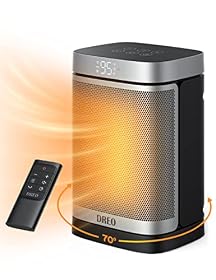 DREO Space Heater, Portable Electric Heaters for Indoor Use with ThermostatDREO
$49.99 as of
View on Amazon GiveBest Space Heater, Portable Space Heaters for Indoor UseGiveBest
$26.99 as of
View on Amazon
Product prices and availability are accurate as of the date/time indicated and are subject to change. Any price and availability information displayed on Amazon.com at the time of purchase will apply to the purchase of this product.
Tabletop placement
Use a tabletop only if the heater’s instructions explicitly permit it. Choose a stable, level, heat-resistant surface that can support the heater, and follow the specified clearances above, below, and around it. Keep it away from table edges, papers, lamps, curtains, and anything that could be knocked onto it.
An elevated position may send heat toward people or a particular area more directly, depending on the heater’s design. It does not necessarily heat a room more effectively. Do not raise a heater to direct heat at a bed, chair, or other spot unless the manufacturer allows that use and the required clearances can be maintained.
Checks before switching it on
- Read the manual for approved placement, clearance, and surface requirements. If tabletop use is not clearly allowed, keep the heater on the floor.
- Set it on a stable surface and make sure the intake and outlet are clear.
- Plug it directly into a wall outlet. Avoid extension cords and power strips unless the manufacturer explicitly permits them.
- Keep the cord out of walkways and away from hot surfaces. Stop using the heater if the plug or cord becomes damaged or unusually hot.
- Turn the heater off and unplug it before moving or cleaning it. Never leave it running unattended or while sleeping unless the manual specifically supports that use and all safety directions are followed.
If the heater cannot be positioned with the required clearances, choose a different location or a heater designed for the space. Do not try to make an unsuitable tabletop placement safe with a small mat or improvised barrier.
FAQ
Can I put a space heater on a table?
Only if the manufacturer’s instructions explicitly allow tabletop use. The surface must be stable, level, and heat-resistant, and all required clearances must be maintained.
Is it better to put a space heater on the floor?
For most portable heaters, yes. Floor placement is the intended setup unless the manual says otherwise. Keep the heater on a firm, level surface with its airflow openings clear.
How far should a space heater be from furniture?
Keep it at least 3 feet from combustible items such as furniture, curtains, and bedding, or farther if the manufacturer requires more clearance.
Does raising a space heater make it heat a room better?
Not necessarily. Elevation may direct heat toward a nearby area, but room heating depends on the heater’s design and airflow. Follow its placement instructions rather than raising it to improve performance.