Space Heater for a Garage Workshop: Safety and Sizing Guide
A garage workshop needs more than a heater with a high wattage rating. The right choice depends on the room’s insulation, electrical circuit, dust and vapor hazards, and whether you need fast spot heat or steady background warmth.
What do you need help with?
Open an answer, or tell us what we should cover next.
Answered in this guide
Choose the right space heater for a garage workshop
Match the heater to how you work: use a ceramic fan heater for quick area heat, infrared for directed spot warmth, oil-filled heat for quiet background warmth, or a fixed workshop heater when portable options are unsuitable.
Check whether a portable heater is safe for your workshop
Avoid portable heaters where flammable vapors, heavy combustible dust, persistent moisture, or electrical limitations create unsafe conditions. In those cases, use a heating system designed specifically for the space instead.
Do not rely on wattage alone. Portable heaters may provide useful spot heat but struggle to warm a poorly insulated garage evenly, so consider insulation, room conditions, and whether you need quick or steady warmth.
Check the electrical circuit before using a space heater
Compare the heater’s wattage with the outlet’s circuit capacity before plugging it in. Estimate current by dividing watts by volts; a 1,500-watt heater on 120 volts draws about 12.5 amps.
Request a topic and help us choose what to build next.
Calculate what it will cost to run the heater
Improve garage insulation to reduce heating needs
Install a fixed heating system in the workshop
Requests help us prioritize the next guide. No email required.
One anonymous request per topic.
Space heater for a garage workshop
A space heater can make a garage workshop more comfortable, but the safest choice depends on more than room size. Before buying, consider insulation, drafts, available electrical capacity, sawdust and other combustibles, flammable vapors, and whether you want to heat the entire space or only your work area.
For many workshops, a listed electric heater with a thermostat, overheat protection, and a tip-over switch is the most practical option. However, no portable heater should be placed near gasoline, solvents, spray finishes, propane cylinders, sawdust buildup, or other easily ignited materials. Follow the heater’s manual and local electrical and fire-safety requirements.
Start with the workshop’s hazards
A garage workshop can be a more demanding environment than a bedroom or office. Check these conditions before choosing a heater:
Flammable liquids or vapors: Gasoline, lacquer thinner, paint thinner, aerosols, and some finishes can produce ignitable vapors. Do not use a heater that can create an ignition source near these materials. A standard portable heater may not be suitable for that area at all.
Combustible dust: Wood dust and other fine particles can accumulate around heaters, motors, and electrical equipment. Keep the heater away from dust-producing tools and clean the area regularly.
Sawdust and debris: Do not allow debris to collect around the intake or outlet. Never cover the heater.
Moisture: A damp garage, vehicle-washing area, or concrete floor may require a heater specifically rated for the environment. Keep portable electric heaters away from water and wet locations unless the manufacturer explicitly allows that use.
Vehicle exhaust and fuel storage: Never operate a fuel-burning heater in a closed garage or any space where carbon monoxide can accumulate. A garage door being partly open is not a substitute for following the heater’s ventilation requirements.
If your work regularly involves flammable vapors, combustible dust, welding, or spray finishing, consult a qualified professional about a fixed heating system designed for that environment rather than relying on a general-purpose portable heater.
Choose the heater type based on how you work
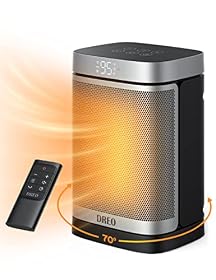
Ceramic fan heater: quick heat for a small work area
A ceramic heater with a fan can warm the air near a bench relatively quickly. It is useful when you need short-duration heat while working in one part of the garage.
The fan can also move dust, and the intake may become restricted in a dirty workshop. Keep it well away from sawdust, shavings, paper, fabric, and finishes. A fan heater is usually less useful for heating a large, drafty garage evenly.
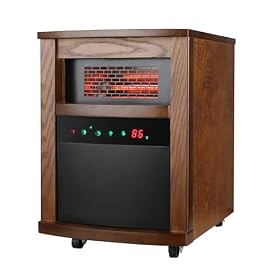
Infrared heater: directed heat for spot warming
Infrared heaters warm people and nearby surfaces more directly than they warm the entire air volume. This can make sense when you work at one bench and do not need the whole garage heated.
Placement is especially important. Keep the heating element and hot surfaces away from combustible materials, and follow the required clearance distances in the manual. Do not assume that a wall, ceiling, or overhead mounting location is permitted unless the product is designed and approved for it.
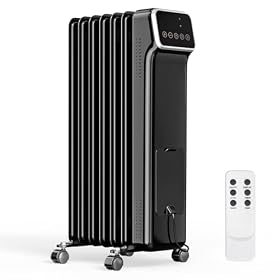
An oil-filled radiator provides gradual, quiet heat and does not use a fan to blow dust around. It can work well for maintaining a more stable temperature in a relatively clean, enclosed workshop.
It is not an instant-heating solution, and its surfaces can become hot. Leave the specified clearance around the radiator and do not use it as a way to dry clothing, rags, or materials.
Fixed garage or workshop heater
For frequent use, a permanently installed heater may be more appropriate than a portable unit. Fixed equipment can be selected for the building’s electrical service, ventilation needs, mounting location, and local code requirements.
Installation may require a qualified electrician or HVAC professional. This is particularly important if the garage has a dedicated high-power circuit, unusual wiring, a flammable-work area, or insufficient ventilation.
Product prices and availability are accurate as of the date/time indicated and are subject to change. Any price and availability information displayed on Amazon.com at the time of purchase will apply to the purchase of this product.
Estimate the heating demand realistically
Portable electric heaters commonly have limited output because they are designed to plug into ordinary household circuits. A heater’s wattage is not the same as the amount of heat you will feel throughout a poorly insulated garage.
Consider:
Square footage and ceiling height: A tall or oversized garage contains more air than its floor area suggests.
Insulation: Insulated walls, a sealed garage door, and an insulated ceiling reduce heat loss.
Drafts: Gaps around doors and windows can overwhelm the output of a small heater.
Starting temperature: A heater that maintains a tolerable temperature may struggle to rapidly warm a freezing workshop.
Work pattern: Spot heating can be more efficient for one person at one bench than attempting to heat the whole garage.
If the garage is uninsulated or frequently opened, improving weatherstripping and insulation may provide more benefit than moving to a slightly larger portable heater. Never block required ventilation or make modifications that conflict with the garage door’s operation or local building requirements.
Product prices and availability are accurate as of the date/time indicated and are subject to change. Any price and availability information displayed on Amazon.com at the time of purchase will apply to the purchase of this product.
Check the electrical circuit before plugging it in
Look at the heater’s wattage and the circuit serving the outlet. Electrical current can be estimated with:
amps = watts ÷ volts
For example, a 1,500-watt heater on a 120-volt supply draws about 12.5 amps. That can use most of the capacity of a typical household circuit, leaving less capacity for saws, compressors, battery chargers, lights, or other tools.
Use these precautions:
Plug the heater directly into a properly grounded wall outlet unless the manufacturer specifically states otherwise.
Avoid power strips and extension cords. If an extension cord is unavoidable and the manual permits it, use a cord with the correct rating and length, fully uncoiled, and suitable for the heater’s load.
Do not run a heater from the same circuit as a high-draw power tool if doing so could trip the breaker or overheat wiring.
Stop using the heater if the plug, outlet, or cord becomes hot, discolored, loose, or damaged.
Do not use a heater with a damaged cord, missing ground connection, defeated safety switch, or improvised repair.
If you are unsure which outlets share a circuit or whether the garage wiring can handle the load, ask a qualified electrician. Do not replace a breaker with a larger one to stop nuisance trips unless the wiring and entire circuit are properly evaluated.
Product prices and availability are accurate as of the date/time indicated and are subject to change. Any price and availability information displayed on Amazon.com at the time of purchase will apply to the purchase of this product.
Features that matter in a garage workshop
Prioritize safety and control features over decorative settings:
Tip-over switch: Shuts the heater off if it is knocked over. It does not make unsafe placement acceptable.
Overheat protection: Helps reduce risk if airflow is restricted, but it is not a substitute for keeping the intake and outlet clear.
Adjustable thermostat: Maintains a target temperature instead of running continuously.
Low and high heat settings: A lower setting can reduce circuit demand and provide enough comfort for a small work area.
Stable base or approved mounting: Important around benches, cords, and moving tools.
Controls that are easy to reach safely: You should not have to move materials or reach across hot surfaces to turn it off.
A filter only when the manufacturer specifies one: A removable filter can be useful on some fan-equipped heaters, but do not add an aftermarket filter or operate the unit with a blocked intake.
Look for a recognized safety certification mark appropriate to your region, and confirm that the heater is intended for the location where you plan to use it. A bathroom-rated heater is not automatically suitable for a dusty or solvent-using workshop.
Product prices and availability are accurate as of the date/time indicated and are subject to change. Any price and availability information displayed on Amazon.com at the time of purchase will apply to the purchase of this product.
Place the heater safely
Set up the heater on a level, noncombustible surface where it cannot be struck by a board, tool, vehicle, door, or rolling equipment. Keep the outlet aimed into open space and maintain every clearance specified by the manufacturer.
Keep the heater away from:
Wood scraps, cardboard, rags, curtains, and clothing
Sawdust collection points and active cutting areas
Paint, solvents, fuel, propane, and aerosol cans
Water, sinks, wet floors, and melting snow from vehicles
Walkways where the cord can create a trip hazard
Areas where the heater can be buried under materials
Turn it off when leaving the garage, going to sleep, or when the heater cannot be monitored. A thermostat or timer should not be treated as permission to leave a portable heater running unattended.
When a portable heater is the wrong choice
Choose a different heating approach if the workshop contains flammable vapors, heavy combustible dust, persistent moisture, or electrical limitations that prevent safe operation. A fixed system designed for the space may be safer and more effective.
A replacement portable heater may be reasonable when the existing unit has a damaged cord, unreliable controls, repeated overheating shutdowns, unusual odors, visible damage, or a failed tip-over switch. Do not bypass a safety device or continue using a heater that trips a breaker without finding the cause.
For a small, clean, well-organized work area, a portable electric heater may be adequate. For a large or drafty garage used every day, address air leaks and consider professional guidance on a fixed heating solution.
FAQ
What type of space heater is best for a garage workshop?
For a clean, dry workshop, the best type depends on how you work. A ceramic fan heater provides quick local heat, an infrared heater is useful for directed spot warming, and an oil-filled radiator provides quieter, gradual background heat. None should be used near flammable vapors, heavy combustible dust, or materials that can contact hot surfaces.
Can I use a space heater in a garage with sawdust?
Use extreme caution. Keep the heater away from cutting and sanding areas, clean dust and debris regularly, keep the intake and outlet unobstructed, and follow the manufacturer’s clearances. If combustible dust is routinely suspended in the air or accumulates heavily, a general-purpose portable heater may not be appropriate.
Can a space heater run on the same circuit as workshop tools?
It may overload the circuit, especially if the heater draws around 1,500 watts and a saw, compressor, or other tool starts on the same circuit. Check the heater’s current draw and the circuit’s other loads. If you are uncertain, use a qualified electrician rather than relying on repeated breaker resets.
Is an extension cord safe for a garage space heater?
Avoid extension cords unless the heater’s instructions specifically allow one. If permitted, the cord must be rated for the heater’s load and used fully uncoiled and undamaged. Power strips and lightweight household extension cords are not suitable substitutes.
Can I use a propane heater in a garage workshop?
Do not assume a propane heater is safe indoors. Fuel-burning heaters can create carbon monoxide, consume oxygen, and ignite vapors. Use only equipment specifically approved for the location and fuel, with the ventilation and clearances required by its instructions and local regulations. When in doubt, consult a qualified professional.