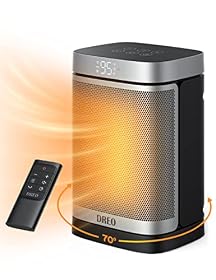
A 1,500-watt rating tells you the heater’s maximum power draw—not that it runs at full power constantly or heats every room equally.
What 1,500 watts means
A 1,500-watt space heater uses up to 1,500 watts of electrical power while heating at its highest setting. The rating is common because it provides substantial heat while staying within the practical limits of a typical 120-volt household outlet.
At 120 volts, a 1,500-watt heater draws about 12.5 amps: watts divided by volts equals amps. That is a large load on a household circuit, so other appliances on the same circuit can cause the breaker to trip.
Product prices and availability are accurate as of the date/time indicated and are subject to change. Any price and availability information displayed on Amazon.com at the time of purchase will apply to the purchase of this product.
How much heat it produces
One watt of electric heat is about 3.412 BTU per hour. At full power, 1,500 watts therefore produces roughly 5,100 BTU per hour. This is a measure of heat output, not a guarantee that the heater will warm a particular room to a comfortable temperature. Room size, drafts, insulation, ceiling height, and outdoor temperature all matter.
A higher wattage generally means more heat output, but it does not automatically mean better efficiency. Nearly all the electricity used by a resistance space heater becomes heat at the point of use. The practical question is whether its heat output suits the room and whether your circuit can support it safely.
Why a heater may use less than 1,500 watts
The 1,500-watt figure is usually the maximum setting. A heater with a lower setting may use less power—for example, a 750-watt setting draws about half as much current at the same voltage. A thermostat can also switch the heating element on and off to maintain the selected temperature, so the heater may not draw its maximum continuously.
Check the heater’s label or manual for its input voltage, wattage, current, and settings. Do not assume that a low thermostat setting reduces the heater’s draw while the heating element is actively on; it may simply make the element run for less time.
What to know about your outlet and circuit
Plug a portable space heater directly into a wall outlet. Do not use an extension cord, power strip, or outlet adapter unless the heater manufacturer explicitly permits it. Avoid running other high-power appliances on the same circuit, and remember that two outlets in different rooms may share one circuit.
If a breaker trips, turn the heater off and unplug it. Reduce the load on that circuit rather than repeatedly resetting the breaker. Stop using the heater if its plug or outlet becomes unusually hot, looks damaged, or smells like burning, and have the outlet or circuit checked by a qualified electrician. Follow the manufacturer’s placement and operating instructions, and keep the heater away from combustible materials.
FAQ
Does a 1,500-watt space heater always use 1,500 watts?
No. It uses up to 1,500 watts on its highest setting while the heating element is on. A lower heat setting or a thermostat cycling the element can reduce its average use over time.
How many amps does a 1,500-watt heater draw?
At 120 volts, it draws about 12.5 amps while heating at full power. The exact current depends on the supply voltage and the heater’s rating.
Does 1,500 watts tell me what size room the heater can heat?
It gives a useful measure of maximum heat output, but room size alone is not enough to predict comfort. Insulation, drafts, ceiling height, and outdoor conditions also affect how well a heater warms a room.