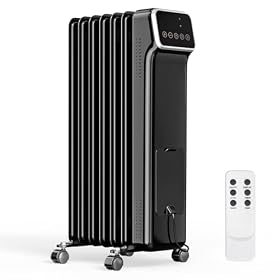
An oil-filled radiator is usually the best space-heater style for steady, quiet warmth rather than fast heat. Here is how to choose the right size, controls, safety features, and placement for your room.
An oil-filled radiator is usually the best choice when you want steady, quiet warmth with fewer hot-and-cold swings. It heats the sealed oil inside the radiator, and that oil gradually releases heat through the metal fins. This takes longer than a fan heater, but the warmth is gentle and continues briefly after the heating element cycles off.
Why oil-filled heaters feel more even
Oil-filled heaters warm the surrounding air through a large heated surface instead of relying mainly on a high-speed fan. That makes them useful for bedrooms, home offices, nurseries, and other rooms where noise and drafts are unwelcome.
Their main advantages are:
Quiet operation: Most do not need a continuously running fan.
Steady heat: The radiator stores heat and releases it gradually.
Less noticeable airflow: They are less likely to blow dust around than fan-based heaters.
Good thermostat behavior: Once the room reaches the set temperature, the element can cycle on and off while the radiator remains warm.
The tradeoff is slower warm-up. If you need heat immediately after entering a cold room, a ceramic fan heater or infrared heater may feel faster. An oil-filled model is better suited to maintaining comfort over longer periods.
What to look for when choosing one
Match wattage to the room
Choose wattage based on room size, insulation, ceiling height, outdoor temperature, and how much heat the room loses. Use the manufacturer's room-size guidance as a starting point rather than assuming every heater with the same wattage will perform identically.
A higher-wattage heater is not automatically better. A model that is too large may cycle frequently, while an undersized model may run continuously without reaching the desired temperature. In a poorly insulated room, better weatherstripping or closing drafts may improve comfort more than moving to a larger heater.
Many household portable heaters are designed around the electrical capacity of a standard wall outlet, but always verify the heater's rated voltage and power draw. Do not use an extension cord or power strip unless the manufacturer specifically permits it; high-wattage heating appliances should generally plug directly into an appropriate wall outlet.
Choose a useful thermostat
A thermostat is more important for even warmth than having many heat settings. Look for controls that let you set a target temperature or clearly cycle the heater on and off. Basic dial thermostats can work well, but their markings may be less precise than a digital control.
A thermostat measures the air near the heater, not every part of the room. Placement therefore matters. Keep the unit away from cold drafts, exterior doors, and curtains that could affect airflow around the thermostat.
Consider heat settings and energy use
Multiple heat settings can help match output to the room. A lower setting may be enough once the room is comfortable, while a higher setting can shorten the initial warm-up period.
A heater does not become more efficient simply because it has a more advanced display. Portable electric resistance heaters convert incoming electricity into heat at broadly similar rates. The practical energy differences usually come from:
How much power the selected setting uses
How long the heater runs
How accurately the thermostat maintains the set temperature
Whether a timer prevents unnecessary operation
A timer or programmable schedule is useful if the room only needs heat at particular times. It should not be used as a substitute for safe supervision or the manufacturer's operating instructions.
Prioritize safety features
Look for a stable base, overheat protection, and a tip-over switch that shuts the heater off if it is knocked over. These features reduce risk but do not make unsafe placement acceptable.
Keep the heater on a level, hard, nonflammable surface with clear space around it. Keep bedding, clothing, paper, furniture, curtains, and other combustible materials away from the radiator. Do not cover the heater, dry clothes on it, use it in a bathroom unless it is specifically rated for that location, or leave it operating where the manufacturer's instructions prohibit unattended use.
Check the plug and cord periodically for damage, unusual heat, discoloration, or a loose connection. Stop using the heater if the cord, plug, controls, or casing appears damaged.
Product prices and availability are accurate as of the date/time indicated and are subject to change. Any price and availability information displayed on Amazon.com at the time of purchase will apply to the purchase of this product.
When an oil-filled heater is the right choice
Choose an oil-filled radiator when you want:
Quiet heat for sleeping or working
Gradual, room-wide comfort rather than a strong stream of hot air
Heat that remains gentle after the element cycles off
A heater for longer operating periods under thermostat control
It may not be the best choice when you need:
Very fast spot heating
A compact unit that can be aimed directly at one person
Cooling airflow in warmer weather
A heater that is easy to carry frequently, since oil-filled radiators can be relatively heavy
For a drafty garage, workshop, or large open area, confirm that the heater is approved for that environment. A typical household oil-filled radiator may not be suitable for damp locations, construction areas, or spaces with unusual electrical demands.
Product prices and availability are accurate as of the date/time indicated and are subject to change. Any price and availability information displayed on Amazon.com at the time of purchase will apply to the purchase of this product.
Placement for more even warmth
Place the heater where air can circulate freely around its fins. Avoid pushing it tightly against a wall or placing furniture directly in front of it. Positioning it near a cold exterior wall can help offset that cold surface, but it must still maintain the clearance distances specified in the manual.
Keep doors and windows closed while heating the room, and address obvious drafts. If the room has several distinct zones, one portable heater may warm the area around it without making the entire space comfortable. In that situation, a correctly located heater or a permanent heating solution may work better than simply increasing the setting.
Product prices and availability are accurate as of the date/time indicated and are subject to change. Any price and availability information displayed on Amazon.com at the time of purchase will apply to the purchase of this product.
Common problems and practical checks
The heater runs but the room stays cold
First check that the selected heat setting is active and that the thermostat is not set below the current room temperature. Then check for open doors, window drafts, high ceilings, and poor insulation.
Make sure the heater has adequate clearance and is not blocked by furniture. Confirm that the model's rated output and room guidance are appropriate for the space. If the heater is undersized or the room loses heat rapidly, replacing it with another similar-size unit may not solve the problem; improving insulation or using the room's primary heating system may be more effective.
The heater turns off too soon
The thermostat may be sensing warmer air directly around the radiator than the rest of the room. Move the heater to a more open location while maintaining the required clearances. Keep it away from drafts and do not place it directly beneath a shelf or behind furniture.
If the unit repeatedly shuts down even in an open location, check for an overheat condition, blocked airflow, or a fault indicated by the manual. Unplug it and discontinue use if it smells hot, makes abnormal noises, shows damage, or trips the circuit breaker.
The heater is noisy
A small click when the thermostat cycles can be normal. Occasional expansion or contraction sounds from the metal housing may also occur as the heater warms and cools.
Persistent buzzing, crackling, grinding, or an electrical smell is not something to ignore. Turn the unit off, unplug it when safe, and consult the manufacturer's instructions or a qualified technician. Do not open or repair the heater yourself unless you are specifically qualified and the manufacturer permits that repair.
The plug or outlet becomes hot
Stop using the heater if the plug, cord, or outlet becomes unusually hot, discolored, loose, or damaged. Do not substitute a power strip or extension cord. Have the outlet inspected by a qualified electrician before using a high-wattage heater there.
Bottom line
The best oil-filled heater for even warmth is one with enough output for the room, a dependable thermostat, stable construction, overheat protection, and a tip-over switch. Favor a model with controls you will actually use over unnecessary features. Choose an oil-filled radiator for quiet, sustained comfort; choose a fan-based or infrared heater instead if rapid spot heating is your priority.
FAQ
Are oil-filled heaters good for even room heating?
Yes. Their large heated surface and thermal mass provide gradual, steady warmth with less airflow than fan heaters. They work best in enclosed rooms that are reasonably well insulated and correctly sized for the space.
Do oil-filled heaters use a lot of electricity?
They use electricity according to their selected power setting and run time. Oil-filled heaters are electric resistance heaters, so their main energy-saving advantage comes from thermostat control, lower settings, scheduling, and avoiding heat loss—not from a special oil-based efficiency effect.
How long does an oil-filled heater take to warm a room?
Warm-up time depends on wattage, room size, insulation, outdoor temperature, and starting temperature. Oil-filled models generally warm more slowly than fan heaters but provide steadier comfort once the radiator is hot.
Can I leave an oil-filled heater on overnight?
Follow the specific manufacturer's instructions. Use only a heater with appropriate safety features, place it on a stable hard surface with clearances, plug it directly into a suitable wall outlet, and keep all combustible materials away. Do not use a damaged heater or one that shows overheating or electrical problems.