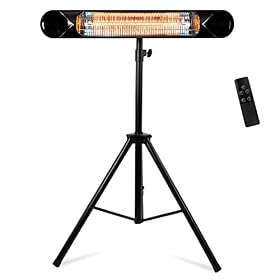
A garage needs more than a high-wattage heater. Choose a model specifically approved by its manufacturer for garage use, then match its voltage, wattage, mounting method, and safety features to the space.
Garage-rated space heater
A garage-rated space heater should be specifically approved by its manufacturer for garage use—not simply marketed as powerful or placed in a garage by the owner. Garages can contain sawdust, solvents, gasoline vapors, vehicle exhaust, and damp concrete floors, so heater placement and electrical requirements matter as much as heat output.
For many garages, a permanently mounted electric heater is the safer choice than a portable household heater. Before buying, check the heater’s installation instructions, the garage’s electrical circuit, and local code requirements. If the heater requires new wiring, a 240-volt circuit, hardwiring, or ceiling installation, use a qualified electrician.
What “garage-rated” should mean
There is no single universal rating that makes every space heater safe for every garage. A suitable product should have clear manufacturer instructions stating that it can be used in a garage, workshop, or comparable utility space. The instructions should also identify restrictions involving dust, moisture, flammable vapors, mounting height, ventilation, and minimum clearance.
Be cautious with a standard bedroom or living-room heater. A tip-over switch, overheat protection, and a cool-touch exterior are useful safety features, but they do not automatically make a household heater suitable for a garage.
A garage heater may be:
Wall-mounted or ceiling-mounted: Keeps the heating appliance away from vehicles, stored items, cords, and floor moisture.
Portable electric: Easier to move but more vulnerable to being knocked over, covered, or connected to an unsuitable extension cord.
Infrared or radiant: Warms people and nearby surfaces directly rather than heating all the air evenly.
Fuel-burning: Requires careful ventilation and carbon-monoxide protection. These models should be used only exactly as directed by the manufacturer.
Choose the heating approach first
Electric forced-air heaters
These use a fan to circulate warm air. They can raise the air temperature relatively quickly and are useful when you need broader heat distribution. Look for adjustable heat settings, a thermostat, overheat protection, and a housing and mounting system approved for the intended environment.
Fan noise, dust intake, and the location of the air inlet matter in a workshop. A heater that draws in airborne sawdust may require more frequent cleaning or may be unsuitable for particularly dusty work.
Infrared heaters
Radiant heaters can be useful when you spend time at one workbench or need heat directed toward a person. They may not warm the entire garage evenly, especially when doors open frequently. Keep the heating element and its required clearance away from cardboard, lumber, fabric, solvents, and vehicle parts.
Oil-filled radiators
Oil-filled radiators provide gentle, quiet heat, but they are generally floor-standing appliances. That can be a poor fit in a garage where they could be struck, tipped, exposed to moisture, or blocked by stored materials. Consider one only when the manufacturer explicitly permits garage use and you can maintain all required clearances.
Fuel-burning heaters
Propane, kerosene, and other combustion heaters can produce substantial heat, but they introduce fire, ventilation, and carbon-monoxide risks. Never assume that opening a garage door makes an indoor-rated combustion heater safe. Follow the instructions for fuel type, ventilation, clearance, and carbon-monoxide detection. Do not use a fuel-burning heater near gasoline, solvents, paint fumes, or other flammable vapors.
Product prices and availability are accurate as of the date/time indicated and are subject to change. Any price and availability information displayed on Amazon.com at the time of purchase will apply to the purchase of this product.
Match wattage and voltage to the garage
A heater’s wattage indicates how much electrical power it consumes at its rated setting; it does not guarantee a particular temperature increase. Insulation, ceiling height, air leakage, outdoor temperature, garage-door openings, and the desired indoor temperature all affect performance.
A small, insulated, enclosed garage may need less heating capacity than a large unfinished garage with gaps around the door. A larger heater is not automatically better if the circuit cannot safely support it.
Check 120-volt versus 240-volt requirements
Many portable heaters use a standard household-style 120-volt supply, while larger permanently installed garage heaters may require 240 volts. A 240-volt heater may be appropriate for higher-output installation, but it typically requires a dedicated circuit and suitable wiring.
Do not plug a heater into a circuit merely because the receptacle fits. Check the heater’s current requirement, the circuit rating, and what else shares that circuit. Avoid using an extension cord unless the manufacturer specifically permits it and provides requirements for cord type and capacity. Never use a power strip for a high-load heater.
A qualified electrician should handle new circuits, hardwiring, breaker changes, or uncertainty about grounding and outlet condition.
Product prices and availability are accurate as of the date/time indicated and are subject to change. Any price and availability information displayed on Amazon.com at the time of purchase will apply to the purchase of this product.
Safety features and installation details to prioritize
Look for the following when they are appropriate to the heater type and installation:
Explicit garage or workshop approval in the manual
Overheat protection and an automatic shutoff
Tip-over protection for a portable unit
A thermostat to reduce unnecessary continuous operation
A guarded heating element where applicable
A sturdy mounting bracket for wall or ceiling installation
Clearance instructions that can actually be followed in your garage
A sealed or suitably protected control area when the manufacturer specifies protection from dust or moisture
A suitable plug, grounding arrangement, and circuit requirement stated in the documentation
A heater’s safety controls do not replace correct placement. Keep it away from gasoline containers, solvents, paint, sawdust piles, cardboard, curtains, vehicles, and pathways. Do not cover the unit or block its air intake and outlet.
If the garage is damp, has a history of flooding, or has a wet floor, do not use a portable electric heater where it could contact water. Follow the manufacturer’s instructions for wet or damp locations, and have questionable electrical conditions inspected before use.
Product prices and availability are accurate as of the date/time indicated and are subject to change. Any price and availability information displayed on Amazon.com at the time of purchase will apply to the purchase of this product.
Portable versus mounted garage heaters
Choose a portable unit when you need occasional spot heating, have a dry and uncluttered location, and can supervise it while operating. It should sit on a stable, level surface with its cord protected from foot and vehicle traffic.
Choose a mounted unit when you want more consistent heating, need to keep the floor clear, or routinely work around vehicles and equipment. Mounting height, bracket strength, airflow, and wiring are installation issues—not just product features.
A mounted heater is not automatically safe if it is installed too close to the ceiling, storage, insulation, or combustible surfaces. Use the exact clearances in the manual.
When a garage heater is the wrong solution
A space heater may not be suitable if:
The garage contains gasoline vapors, solvents, spray finishes, or other flammable fumes.
Fine dust is regularly suspended in the air and the heater is not approved for that environment.
The electrical circuit is overloaded, damaged, ungrounded, or shared with demanding tools.
You cannot maintain the required clearance from stored materials or vehicles.
You need unattended heating for long periods.
The garage has substantial air leakage and the heater would run continuously without maintaining a reasonable temperature.
Improving weatherstripping, insulating the garage door, sealing obvious air leaks, and limiting door openings may improve comfort more safely and efficiently than simply buying a larger heater.
A practical buying checklist
Before purchasing, confirm:
The manual expressly permits the intended garage or workshop use.
The heater’s voltage and current match an appropriate circuit.
The required clearance fits your available wall, ceiling, or floor space.
The unit is suitable for the garage’s dust and moisture conditions.
The thermostat and heat settings fit how you use the space.
The installation does not require an extension cord or power strip.
You can keep combustibles, vehicles, and stored items outside the specified clearance zone.
You understand whether the heater is intended for spot heating or whole-room heating.
If you cannot verify these points from the manufacturer’s documentation, choose another product or ask a qualified professional before installing it.
Only if the manufacturer specifically permits that model’s use in a garage or comparable utility space. Indoor safety features such as tip-over and overheat protection do not automatically make a household heater suitable for garage dust, moisture, flammable vapors, or vehicle-related hazards.
What type of heater is safest for a garage?
There is no single safest type for every garage. A properly installed electric heater specifically approved for garage use is often easier to control than a fuel-burning heater because it does not produce combustion exhaust. The best choice still depends on the garage’s electrical system, dust, moisture, storage, and ventilation.
Is a 240-volt garage heater better than a 120-volt heater?
Not necessarily. A 240-volt model may support higher-output installation, but it generally requires an appropriate dedicated circuit and professional electrical work. A 120-volt heater may be more convenient for occasional use, provided its load is suitable for the circuit and the manufacturer approves garage use.
Can I run a garage space heater overnight?
Avoid unattended operation unless the manufacturer explicitly allows it and the installation meets all requirements. Never leave a portable heater operating near combustible storage, vehicles, dust, or flammable vapors, and do not bypass any safety shutoff.
Do I need a carbon-monoxide detector with a garage heater?
Use carbon-monoxide protection whenever combustion equipment or a vehicle may produce exhaust, but a detector does not make an improperly ventilated heater safe. Electric heaters do not produce carbon monoxide during operation. Follow the heater instructions and local safety requirements.