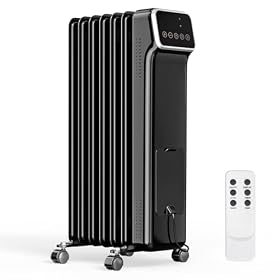
A compact electric heater can warm a walk-in closet office, but the tight layout makes clearance, outlet capacity, and automatic safety controls especially important.
A compact electric space heater can work in a walk-in closet office, but only if the heater has open space around it and can be plugged directly into a suitable wall outlet. Choose a model with a thermostat, tip-over shutoff, and overheat protection, then keep clothing, boxes, curtains, and office furniture well away from the heater.
What to look for
Compact ceramic heater
A small ceramic heater is usually the most practical choice for a closet office because it warms up quickly and is easier to position than a larger radiator. Look for:
Adjustable heat settings
A thermostat or temperature control
Tip-over shutoff
Overheat protection
A stable base
A cord long enough to reach the wall outlet without an extension cord
Controls that are easy to operate without reaching behind furniture
Do not choose a heater solely because it is physically small. A compact unit can still draw substantial power, and a heater with blocked air intake or exhaust can overheat.
Oil-filled radiator
An oil-filled radiator provides steady, quiet heat and does not blow air around the room. However, it is often a poor fit for a narrow closet office because it needs open space around its hot surfaces and may occupy more floor area. It can be appropriate only if the room layout allows the clearances specified in the manual.
Fanless or low-power options
A lower-power heater may reduce the load on the circuit, but it will also produce less heat. Check the heater's actual wattage rather than judging by its size. A 1,500-watt heater draws about 12.5 amps on a 120-volt circuit; a 750-watt setting draws about 6.25 amps. Other devices on the same circuit can reduce the available capacity.
Safety matters more in a closet office
Clothing and stored items can catch fire if they contact a heater or get close enough to become overheated. Before buying, identify a permanent heater location with:
A clear area around the heater, following the manufacturer's required clearances
No hanging clothes, fabric bins, paper, blankets, or boxes above or beside it
No desk panel, chair, or storage shelf blocking the air intake or outlet
A stable, level surface that the manufacturer permits
A direct path to the wall outlet
As a conservative rule, keep a roughly three-foot zone free of anything that can burn unless the manufacturer requires even more space. Do not put a portable heater inside a cabinet, under a desk where airflow is restricted, or behind a door that can close against it.
Never leave a portable heater running while you are away, asleep, or unable to monitor it. If the office is used for long work sessions, a thermostat can reduce cycling and help maintain a more consistent temperature, but it does not make unattended operation safe.
Product prices and availability are accurate as of the date/time indicated and are subject to change. Any price and availability information displayed on Amazon.com at the time of purchase will apply to the purchase of this product.
Check the electrical setup
Plug the heater directly into a properly installed wall outlet. Do not use an extension cord, power strip, multi-outlet adapter, or smart plug unless the heater manufacturer specifically permits that arrangement and the device is rated for the load.
Before use, check that:
The plug fits firmly in the outlet.
The cord is not pinched, covered by a rug, or routed through a doorway.
The outlet, plug, and cord do not become hot during operation.
No other high-draw appliance is sharing the circuit if the circuit is already heavily loaded.
The heater is the voltage and electrical type specified for your home.
Stop using the heater if you smell burning plastic, see discoloration, hear persistent buzzing or arcing, or notice a hot plug or outlet. Turn it off and unplug it when safe to do so. Have questionable wiring or an overloaded circuit evaluated by a qualified electrician.
Product prices and availability are accurate as of the date/time indicated and are subject to change. Any price and availability information displayed on Amazon.com at the time of purchase will apply to the purchase of this product.
How much heat does the office need?
A closet office often needs less heat than a full bedroom, but the actual requirement depends on ceiling height, insulation, outside walls, windows, air leakage, and whether the door stays open. Start with the lowest heat setting that keeps you comfortable rather than defaulting to maximum power.
A thermostat is more useful than a large number of heat settings because it can cycle the heater as the room reaches the selected temperature. If the heater runs continuously without warming the space, the room may be losing heat too quickly, the heater may be undersized, or airflow may be restricted.
Do not seal the room so tightly that the door cannot open easily or that the heater's exhaust is trapped. Electric heaters do not burn fuel or normally require combustion ventilation, but the heater still needs unobstructed airflow and the room should remain accessible.
Best placement for a walk-in closet office
Place the heater on the floor in the open part of the room, away from the desk's footwell and away from clothing storage. Pointing warm air toward your legs can be comfortable, but do not aim it directly at paper, fabric, curtains, or a nearby wall.
Keep the heater where it cannot be knocked over by a chair, footrest, pet, or door. Do not place it on a shelf, desk, bed, or other elevated surface unless the manufacturer explicitly designed it for that use.
If there is no location that provides the required clearance while leaving the doorway and walking path open, a portable space heater is not a suitable solution for that office. Improving insulation, sealing drafts, adjusting the central heating system, or having a properly installed heater evaluated may be safer.
Before buying: a quick checklist
Choose a heater only if all of these statements are true:
It is listed for indoor household use and matches your home's electrical supply.
It has thermostat control, tip-over protection, and overheat protection.
You have a clear floor location that follows the manual's clearance instructions.
You can plug it directly into a wall outlet.
Clothing and stored items can remain outside the heater's safety zone.
You can turn it off whenever you leave or go to sleep.
The circuit can handle its wattage along with the other devices in the room.
If any answer is no, do not solve the problem by using a longer cord, placing the heater closer to your chair, or enclosing the heater. Choose a safer room layout or a professionally installed heating solution instead.
FAQ
What type of space heater is best for a walk-in closet office?
A compact ceramic heater with adjustable heat, a thermostat, tip-over shutoff, and overheat protection is usually the most practical option. It still needs the clearances and airflow specified by its manufacturer.
Can I use a space heater in a closet office with the door closed?
You can use one only if the heater remains properly positioned, has unobstructed airflow, and the room stays accessible. Never close a door against the heater or leave it running while you are away or asleep.
Can I plug a closet-office heater into a power strip or extension cord?
Do not do so unless the heater manufacturer specifically allows it and the equipment is rated for the heater's load. The safer standard practice is to plug the heater directly into a suitable wall outlet.
How many watts should a space heater for a closet office have?
There is no single wattage for every closet office. Room size, insulation, drafts, ceiling height, and the desired temperature all matter. Use the lowest setting that heats the room adequately, and confirm that the circuit can handle the heater and other connected loads.