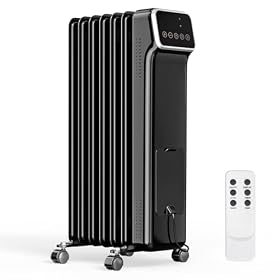
A space heater may overshoot because its built-in sensor measures air near the heater, not the room average. Check placement, operating mode, heater size, airflow, and thermal lag before assuming the thermostat has failed.
A space heater thermostat may overshoot because the sensor is inside or close to the heater, while the rest of the room continues warming after the unit shuts off. Placement, room size, operating mode, restricted airflow, and the heater’s normal temperature differential can all contribute. Use an independent thermometer to confirm the room temperature, then work through these checks before replacing the heater.
Check the thermostat setting and operating mode
Many space heaters do not hold the displayed temperature exactly. Their thermostats typically switch the heating element off at one temperature and back on after the room cools by several degrees. This built-in difference is called a temperature differential or hysteresis.
Also check whether the heater is set to:
High or low heat: High heat adds warmth faster and can create more overshoot.
Eco or automatic mode: This may reduce power or cycle the heater differently than manual heat.
Fan-only mode: Some heaters continue blowing after the heating element turns off.
A timer or schedule: A programmed setting may override the temperature control.
Set the thermostat several degrees below the temperature you actually want and observe several heating cycles. Avoid repeatedly changing the setting every few minutes; the room and furniture can continue releasing stored heat after the heater stops.
Measure the room away from the heater
Use a separate indoor thermometer placed across the room, roughly at sitting or standing height. Keep it away from:
The heater’s exhaust stream
Windows, exterior doors, and drafts
Direct sunlight
HVAC supply vents
Electronics or other heat sources
Compare the independent thermometer with the heater’s display. If the heater’s display says the target temperature has been reached but the room thermometer is still lower, the built-in sensor may be receiving unusually warm air from the heater or its immediate surroundings. If the room is several degrees warmer than the setting, the thermostat may have a large differential, the heater may be oversized, or the sensor may be inaccurate.
Independent thermometer for checking room temperature
Product prices and availability are accurate as of the date/time indicated and are subject to change. Any price and availability information displayed on Amazon.com at the time of purchase will apply to the purchase of this product.
Improve heater placement and airflow
Do not place the heater in a corner, directly beside furniture, under a desk, behind curtains, or close to a wall. These locations can trap warm air around the sensor and cause uneven heating. They can also increase fire risk.
Place the heater on a level, hard, nonflammable surface with the clearances specified in its manual. Keep clothing, bedding, paper, curtains, and furniture away from it. Do not cover the heater or block its intake and outlet.
A small fan can sometimes mix room air, but do not aim airflow at the heater or use a setup that could move combustible items. Follow the heater manufacturer’s clearance and ventilation instructions.
Replacement heater with more controllable heat output
Product prices and availability are accurate as of the date/time indicated and are subject to change. Any price and availability information displayed on Amazon.com at the time of purchase will apply to the purchase of this product.
Consider heater size and thermal lag
A heater that is too powerful for a small, well-insulated room can raise the temperature quickly while the thermostat reacts slowly. This is especially noticeable in a small bedroom, office, or enclosed area.
Oil-filled radiators can overshoot more noticeably because the oil and metal continue releasing heat after the element switches off. Ceramic and fan-forced heaters generally respond more quickly, although the room itself can still retain heat.
If the heater consistently overshoots even on its lowest heat setting, a smaller heater or a model with more precise electronic temperature control may be a better fit. Do not choose a replacement based on wattage alone; consider room size, insulation, ceiling height, drafts, and whether the heater is intended for continuous or occasional use.
Gentler radiant heating option for rooms with thermal lag
Product prices and availability are accurate as of the date/time indicated and are subject to change. Any price and availability information displayed on Amazon.com at the time of purchase will apply to the purchase of this product.
Inspect the filter, intake, and outlet
Restricted airflow can make a heater behave abnormally and may cause its internal sensor or safety control to react to excess heat. With the heater unplugged and fully cool:
Check the air intake and outlet for dust, lint, pet hair, or objects.
Clean only as directed by the manufacturer.
If the unit has a removable filter, inspect or replace it according to the manual.
Confirm that no grille is bent, blocked, or pressed against a wall.
Reconnect power and observe the heater without leaving it unattended.
Never open the electrical housing or bypass a thermal cutoff, tip-over switch, or other safety device. If the heater smells hot, makes unusual noises, shows discoloration, or repeatedly shuts down, unplug it and stop using it.
Check for a faulty thermostat or temperature sensor
The thermostat may need service or replacement if the heater:
Continues heating well above the set point during repeated cycles
Never shuts off in automatic or thermostat mode
Shows an implausible room temperature
Cycles rapidly every few seconds or minutes
Behaves differently after being moved or cleaned
Has a damaged control, loose cord, burn mark, or overheating odor
Some heaters have a user-replaceable control or sensor, but many do not. Use only parts approved for the exact heater and follow the manufacturer’s service instructions. Do not attempt electrical repairs unless you are qualified to perform them safely.
For an older, inexpensive heater with a confirmed thermostat fault, replacing the unit is usually more practical than repairing the control. Replace it immediately if a safety switch, power cord, plug, or overheat protection appears damaged.
Avoid unsafe external thermostat controls
Do not connect a space heater to a power strip, extension cord, or smart plug unless the heater and accessory manufacturers specifically permit that combination. Portable heaters draw substantial current, and unsuitable accessories can overheat.
A separate plug-in thermostat or temperature controller should not be used as a universal fix. It must be explicitly rated for the heater’s electrical load and approved for that type of appliance; otherwise, use the heater’s built-in controls or choose a model designed for external thermostat operation.
When replacement makes sense
Replace the space heater when the thermostat remains inaccurate after correcting placement and settings, when the unit has electrical or overheating damage, or when it is too large for the room and cannot regulate gently on its lowest setting. Choose a heater with clearly specified thermostat and safety features, including tip-over protection and overheat protection, and operate it according to the manual.
Never leave a portable space heater running unattended or while sleeping unless the manufacturer’s instructions specifically address that use and local safety guidance permits it.
FAQ
Why does my space heater keep heating after it reaches the set temperature?
The heater may have a normal temperature differential, and the room may continue warming from stored heat after the element shuts off. A sensor near the heater can also read differently from the room. Confirm the actual room temperature with a separate thermometer and check the heater’s mode and placement.
How much temperature overshoot is normal for a space heater?
There is no universal amount because thermostat design, heater type, room size, insulation, and placement vary. A small difference between the setting and the room temperature can be normal. Persistent or large overshoot, failure to shut off, rapid cycling, or overheating suggests a control or airflow problem.
Can I use a smart plug to control a space heater thermostat?
Do not assume a smart plug is suitable. Portable heaters draw high current, and some will not safely resume operation when power is restored. Use an external controller only when both the heater and controller manufacturers explicitly approve it and the electrical ratings match.
Is an oil-filled radiator more likely to overshoot than a ceramic heater?
It can be, because an oil-filled radiator retains and releases heat after its element switches off. A ceramic fan heater often responds faster, but either type can overshoot if it is oversized, poorly placed, or using a thermostat with a wide temperature differential.