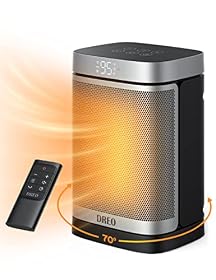
A space heater with a thermostat and timer can maintain a more comfortable temperature while reducing unnecessary runtime. Here’s what to look for before buying.
A space heater with a thermostat and timer can warm a room without running continuously. The thermostat helps maintain a target temperature, while the timer lets you schedule when the heater starts or stops. For most buyers, the important choices are thermostat behavior, timer type, wattage, room size, and safety features—not simply the highest heat output.
How the thermostat works
A heater’s thermostat monitors the surrounding air and cycles the heating element on and off to maintain a selected setting. It does not usually provide the same precise temperature control as a central HVAC system, and the temperature near the heater may differ from the temperature across the room.
Look for:
An adjustable thermostat: This lets you select a preferred comfort level rather than using only low, medium, or high heat.
Automatic cycling: The heater should stop heating when the room reaches the selected setting and restart when the temperature drops.
A clearly marked control: Digital temperature settings are easier to repeat, while mechanical thermostats are often simpler to operate.
A lower-power mode: Low heat can be useful for maintaining warmth after the room reaches a comfortable temperature.
A thermostat is most useful when the heater will operate for extended periods in an occupied room. If you only need a short burst of warmth, the timer may matter more than precise temperature control.
Choose the right timer type
“Timer” can describe several different functions. Check the product’s instructions before assuming it can perform a particular task.
Countdown timer
A countdown timer turns the heater off after a selected period. This is useful when warming a room before bed or when you want a defined shutoff time. It is generally easier to understand than a scheduling function.
Scheduled start or stop
Some heaters can be programmed to turn on or off at a particular time. This may be useful for a morning routine, but confirm whether the schedule repeats daily, applies once, or resets after a power interruption.
Automatic shutoff timer
Some products use the word timer for an automatic safety shutoff rather than user scheduling. That feature can be helpful, but it does not replace a thermostat or a manually selected operating time.
For bedrooms, a countdown timer that switches the heater off after you fall asleep is often more straightforward than a complex recurring schedule. Avoid relying on any heater unattended unless the manufacturer specifically permits that use and the installation meets its instructions.
Product prices and availability are accurate as of the date/time indicated and are subject to change. Any price and availability information displayed on Amazon.com at the time of purchase will apply to the purchase of this product.
Match wattage to the room and circuit
Most portable electric heaters are designed for standard household outlets, but their power draw can be substantial. A higher wattage generally produces more heat, but it also uses more electricity and places a greater load on the circuit.
Consider:
Room size: Use the manufacturer’s stated coverage guidance as a starting point. High ceilings, poor insulation, drafty windows, and exterior walls can increase heating needs.
Circuit capacity: Do not overload a circuit with other high-draw appliances. If a plug, outlet, or cord becomes hot, stop using the heater and have the electrical setup checked.
Extension cords: Portable heaters commonly require direct connection to a suitable wall outlet. Do not use an extension cord or power strip unless the manufacturer explicitly allows it and the cord is appropriately rated.
Heat setting: A low setting may maintain comfort with less energy, but it may not warm a cold room quickly.
Never connect a heater to a damaged outlet, loose receptacle, or visibly damaged cord. Electrical work or circuit questions should be handled by a qualified professional.
Product prices and availability are accurate as of the date/time indicated and are subject to change. Any price and availability information displayed on Amazon.com at the time of purchase will apply to the purchase of this product.
Decide which heater design fits your use
Ceramic heaters
Ceramic heaters usually provide fast, directional heat and often include a fan. They can warm a person or a small room relatively quickly, but the fan may produce noticeable operating noise. Check whether the model has adjustable airflow, oscillation, and a thermostat.
Oil-filled radiators
Oil-filled radiators warm more gradually and are often quieter because they do not need a fan to distribute heat. They can continue releasing heat after the element cycles off, but they are bulkier and may take longer to warm a room.
Fan-forced heaters
Fan-forced models distribute heated air quickly and may be compact. Noise, airflow, and dust movement can matter in bedrooms, offices, or rooms used by people sensitive to drafts.
The thermostat and timer can be useful on any of these designs. Select the heater style based on whether you prioritize quick heat, quiet operation, portability, or gentle sustained warmth.
Product prices and availability are accurate as of the date/time indicated and are subject to change. Any price and availability information displayed on Amazon.com at the time of purchase will apply to the purchase of this product.
Safety features that should be present
A thermostat and timer do not make a heater risk-free. Look for safety features such as:
Tip-over shutoff: Turns the heater off if it is knocked over.
Overheat protection: Interrupts heating if the unit becomes too hot.
A stable base: Helps prevent accidental tipping.
A grounded or appropriately polarized plug: Use the plug configuration supplied by the manufacturer.
A recognized safety certification: Look for certification markings from an applicable independent safety organization.
Controls that are easy to see: This reduces the chance of accidentally selecting the wrong setting.
Keep the heater on a solid, level, nonflammable surface with clear space around air intakes and outlets. Keep bedding, curtains, clothing, paper, furniture, and other combustible materials well away from it. Do not cover the heater, block its airflow, or place it where it can be knocked over.
Is a thermostat and timer worth paying for?
These features are worthwhile when you want to maintain a room temperature or limit how long the heater operates. A thermostat can reduce unnecessary full-power heating by cycling the unit, although actual energy use depends on insulation, outdoor temperature, room size, and the selected setting.
A timer is especially useful for:
Warming a room before you enter it, if the model supports scheduled starting
Turning the heater off after a set period
Limiting overnight operation
Reducing the chance that a heater is accidentally left running for hours
If the heater is used only for occasional, close-range warmth, a basic model with reliable tip-over and overheat protection may be a better value than a feature-heavy unit.
What to check before buying
Use this checklist when comparing models:
Confirm the timer function. Determine whether it is a countdown, a recurring schedule, a delayed start, or only an automatic safety shutoff.
Check thermostat controls. Verify whether the heater has a true adjustable thermostat or only preset heat levels.
Review room-size guidance. Treat coverage claims as estimates, especially in poorly insulated rooms.
Check noise information. Fan-based heaters can be more noticeable than oil-filled radiators.
Confirm electrical requirements. Follow the voltage, outlet, and cord instructions exactly.
Look for tip-over and overheat protection. These should be standard priorities.
Consider controls and display behavior. A bright display or audible button sounds may be undesirable in a bedroom.
Check portability. A handle, manageable weight, and a stable base matter if you will move the heater between rooms.
Read the restart behavior. Some heaters do not resume operation automatically after a power outage, while others may retain or reset their settings.
Safe setup and troubleshooting
If the heater does not seem to warm the room, first confirm that the thermostat is set above the current room temperature and that the unit is not in fan-only mode. Make sure the timer has not expired.
Next, check that the air intake and outlet are unobstructed and that dust has not accumulated around the grille. Turn the heater off, unplug it, and let it cool before cleaning it according to the manufacturer’s instructions. Do not insert objects into the grille or open the housing.
If the unit shuts off unexpectedly, check whether the tip-over switch has been triggered, whether the heater is on an uneven surface, or whether overheat protection has activated. Allow it to cool and improve clearance around it. If it repeatedly shuts off, produces an unusual smell or sound, damages the plug, or trips the circuit, discontinue use.
Replace a damaged cord, plug, thermostat control, or safety component only with a manufacturer-approved part when replacement is permitted. If the heater has internal electrical damage, repeated faults, or signs of overheating, replacing the unit is usually safer than attempting an informal repair. Consult the manufacturer or a qualified technician for service instructions.
FAQ
Can I leave a space heater with a thermostat and timer running overnight?
Follow the manufacturer’s instructions. A timer and thermostat reduce operating time but do not eliminate fire and electrical risks. Keep the heater clear of combustibles, connect it as directed, and avoid overnight or unattended use unless the manufacturer specifically permits it.
Does a thermostat make a space heater use less electricity?
It can reduce runtime by cycling the heater off after the room reaches the selected temperature. Actual savings depend on the room, insulation, outdoor conditions, thermostat setting, and how long the heater operates.
What is better for a bedroom: a ceramic heater or an oil-filled radiator?
A ceramic heater usually provides faster heat but may create fan noise. An oil-filled radiator generally heats more gradually and quietly. Choose based on whether quick warm-up or quiet sustained heating matters more.
Can I use a space heater with an extension cord?
Usually no. Many manufacturers require direct connection to a suitable wall outlet because heaters draw significant current. Follow the heater’s instructions and do not use a power strip unless the manufacturer explicitly permits it.
Why does my heater turn off before the room feels warm?
The thermostat may be sensing warmer air near the heater, the unit may be in a low or fan-only mode, or the timer may have expired. Check the settings, placement, airflow clearance, and room conditions. Repeated premature shutdowns can indicate an overheat or electrical problem and warrant discontinuing use.