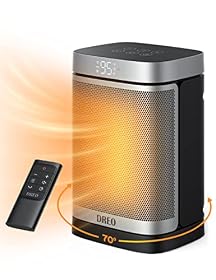
Tower heaters offer a taller heat outlet, broader controls, and often better coverage for occupied rooms. Compact heaters take up less space, store easily, and work well for close-range or occasional heating. The better choice depends on room layout, placement, and how often you move the heater.
A tower space heater is usually the better fit for heating an occupied room, while a compact space heater makes more sense when you need portability, simple close-range warmth, or easy storage. Neither shape automatically heats more efficiently: the important specifications are wattage, thermostat control, heating modes, safety features, and whether the heater is appropriate for the room.
Tower versus compact space heater at a glance
Consideration
Tower space heater
Compact space heater
Best use
Living rooms, bedrooms, offices, and other occupied spaces
Desks, small rooms, temporary heating, and easy portability
Floor footprint
Narrow but usually taller
Small overall footprint, though often wider or lower
Heat distribution
Often better positioned for heating across a room, especially with oscillation
More concentrated heat unless it includes a fan or oscillation feature
Portability
Movable, but less convenient to carry and store
Usually easiest to move and store
Controls
Often includes more modes, timers, and display features
Commonly simpler, though features vary widely
Stability
A wider base can help, but the taller design may be easier to bump
Low-profile designs can feel stable, but stability depends on the base
Storage
Requires more vertical storage space
Fits more easily on a shelf or in a closet
Choose a tower heater when room coverage matters
A tower heater is a practical choice when one person needs warmth in a living room, bedroom, home office, or similar space rather than sitting directly in front of the heater. Its taller form can place the warm-air outlet above floor level, and models with oscillation can distribute air across a wider area.
Look for these features when comparing tower models:
Oscillation: Useful when warmth needs to reach more than one seating position. It does not necessarily increase the heater’s total heat output.
A thermostat: This lets the heater cycle on and off around a target temperature instead of running continuously.
A timer: Helpful for bedtime or scheduled use, but it should not replace safe supervision and proper placement.
A clear power display: Convenient when adjusting settings in a dim room.
A sturdy base and tip-over switch: Important because a taller heater may be more vulnerable to being knocked over.
A tower model may be less convenient if you frequently move the heater between rooms or have very limited storage. Check the heater’s dimensions, not just its width: height can affect where it fits under furniture, beside a bed, or in a closet.
Product prices and availability are accurate as of the date/time indicated and are subject to change. Any price and availability information displayed on Amazon.com at the time of purchase will apply to the purchase of this product.
Choose a compact heater when portability is the priority
A compact space heater is useful for spot heating, temporary use, and rooms where a larger vertical appliance would be inconvenient. It may work well beside a desk or in a small office, provided it is placed on a stable, open surface and the manufacturer allows that placement.
Compact heaters are especially useful when you:
Move the heater between rooms often
Need to store it after each use
Want warmth near one person rather than across a whole room
Have limited floor space
Prefer fewer controls and a simpler setup
Do not assume that a compact heater uses less electricity simply because it is smaller. Electrical consumption depends primarily on the selected wattage and operating time. A small heater running at the same high-wattage setting as a tower model can use a similar amount of electricity.
Product prices and availability are accurate as of the date/time indicated and are subject to change. Any price and availability information displayed on Amazon.com at the time of purchase will apply to the purchase of this product.
Compare wattage with room size carefully
Many household plug-in heaters offer a high heat setting around the upper limit of a standard US household circuit, but wattage varies by model. Always check the heater’s label and manual rather than assuming that two heaters have the same output.
Higher wattage generally means more heat output, but it does not guarantee even heating throughout a room. Room size, ceiling height, insulation, drafts, outside temperature, and open doors can matter just as much.
For either format:
Check the manufacturer’s recommended room size, if provided.
Compare the heater’s wattage and available heat settings.
Consider whether the room has drafts or poor insulation.
Avoid using an undersized heater as a substitute for whole-home heating when the room is difficult to warm.
Plug the heater directly into a properly installed wall outlet unless the manufacturer specifically permits another arrangement. Avoid extension cords and power strips unless the instructions explicitly allow them.
A lower heat setting can reduce power use while still maintaining comfort, but the actual result depends on thermostat behavior and room conditions.
Product prices and availability are accurate as of the date/time indicated and are subject to change. Any price and availability information displayed on Amazon.com at the time of purchase will apply to the purchase of this product.
Tower and compact heater safety differences
Both designs need the same basic precautions. Keep the heater on a level, hard, nonflammable surface with generous clearance from curtains, bedding, clothing, paper, furniture, and other combustible materials. Do not cover the heater or use it to dry clothing.
Important safety features include:
Tip-over shutoff: Turns the heater off if it is knocked over. Confirm that the switch is not blocked by carpet, debris, or an uneven surface.
Overheat protection: Helps shut the heater down if internal temperatures become excessive. It is not a reason to ignore blocked air inlets or outlets.
A cool-touch exterior: Can reduce contact-burn risk, but the air outlet and internal components may still be hot.
A grounded plug or other manufacturer-specified plug design: Do not remove or bypass grounding features.
A tower heater may deserve extra attention to stability because of its height. A compact heater is not automatically safer: it can still be tipped, covered, placed too close to objects, or connected to an overloaded circuit.
Never operate a portable heater while sleeping or when no responsible adult is present unless the manufacturer’s instructions and local safety guidance clearly support that use. Keep children and pets away from the heater, and stop using it if the plug, cord, housing, or controls become damaged or unusually hot.
Which one is quieter?
Noise depends more on the heating technology and fan design than on the heater’s shape. A fan-forced ceramic tower or compact heater may produce a steady airflow sound. An oil-filled radiator generally does not use a fan, although it has a different shape and heating behavior than either a typical tower or compact fan heater.
If noise matters, look for a low or quiet mode and check whether the heater uses a fan. A display that can be turned off may also be useful in a bedroom. Manufacturer noise ratings are not always provided, so avoid treating a shape or marketing label as proof that a heater will be silent.
Which design is easier to clean and maintain?
Compact heaters are often easier to pick up and inspect, while tower heaters may require more attention to narrow air inlets and outlets. In either case:
Turn the heater off and unplug it.
Let it cool completely.
Remove dust from the exterior and air openings according to the manual.
Keep the intake and outlet clear.
Do not spray liquid into the heater or disassemble it unless the manufacturer instructs you to do so.
A heater that repeatedly shuts off may have restricted airflow, an obstructed intake, a dirty filter if the model has one, or an internal fault. Unplug it and consult the manual before trying to use it again.
Tower or compact: the practical decision
Choose a tower space heater if you want:
Warmth distributed around a seating area
Oscillation or more advanced controls
A narrow footprint in a room where vertical space is available
A heater that can serve a larger occupied area than a close-range desk heater
Choose a compact space heater if you want:
The easiest option to carry and store
Close-range warmth for one person
A simple heater for occasional use
A smaller appliance for a desk or small room
If you are undecided, prioritize the heater that fits the room safely, has appropriate wattage, includes tip-over and overheat protection, and offers a thermostat. The tower-versus-compact shape is secondary to correct placement and suitable heating capacity.
FAQ
Does a tower space heater heat better than a compact space heater?
Not necessarily. Heating output depends mainly on wattage, heating technology, airflow, thermostat behavior, and room conditions. A tower may distribute warmth more broadly, especially with oscillation, while a compact heater often provides more direct close-range heat.
Is a compact space heater cheaper to run?
Not automatically. Electricity use depends primarily on wattage and operating time, not the heater’s physical size. Compare the wattage settings and use the thermostat or lower setting when appropriate.
Are tower heaters safer than compact heaters?
Neither shape is inherently safer. Look for tip-over shutoff, overheat protection, a sturdy base, and clear operating instructions. Safe placement and direct connection to an appropriate wall outlet are essential for either design.
Can I use a tower or compact space heater in a bedroom?
Either may be suitable if the manufacturer permits bedroom use and the heater is placed with proper clearance on a stable surface. Keep bedding and curtains away, do not cover the heater, and follow the manual’s instructions about unattended or overnight operation.