A space heater can cost anywhere from a relatively low-cost basic model to a much more expensive heater with quieter operation, stronger controls, improved design, or specialized heating. The exact price changes by heater type, room coverage, safety features, and current retailer promotions, so compare the specifications rather than choosing by price alone.
Price & Buying · Mon Sep 07
How much does a space heater cost to buy
Space heater prices range from basic personal heaters to premium models with quieter operation, better controls, and advanced safety features. Here is what affects the cost and which upgrades are worth paying for.
What determines the purchase price?
Heater type
The heating method is one of the biggest price factors:
- Basic ceramic heaters are often the most accessible option for personal spaces, offices, and small rooms. They commonly include adjustable heat, a thermostat, and basic safety shutoff features.
- Oil-filled radiators may cost more than simple fan-forced heaters because they are designed for steady, quiet heat. They warm up more slowly but do not need a fan running continuously.
- Infrared heaters vary widely in price. The cost can depend on the cabinet design, controls, claimed coverage area, and whether the unit is intended for personal or room heating.
- Large-room or whole-area portable heaters generally cost more because they may have larger heating elements, stronger airflow, more precise controls, or a heavier chassis.
The heating method does not automatically determine efficiency. A heater's electrical consumption depends mainly on its wattage and how long it operates.
Wattage and room coverage
Many portable electric heaters are designed around a standard household outlet and may offer a high heat setting near the outlet's practical limit. Check the heater's label and manual rather than assuming that a higher wattage or advertised coverage area will suit your room.
A larger heater may cost more to buy, but it will not necessarily be cheaper to operate. If two heaters draw the same wattage for the same amount of time, their electricity use is broadly similar. Room insulation, thermostat cycling, outdoor temperature, and the desired indoor temperature often matter more.
Controls and convenience features
Features that can increase the price include:
- Digital temperature settings instead of a basic dial
- A remote control
- A programmable timer or scheduled operation
- Multiple heat settings
- An adjustable thermostat
- An oscillating fan
- A display that can be dimmed or turned off
- A quieter fan or a fanless oil-filled design
- A carry handle, wheels, or a compact footprint
- App control or smart-home compatibility
Pay for features that solve a real problem. A timer can be useful if you regularly warm a room before using it. A quiet design may be worth more in a bedroom or home office. App control is less useful if you will still need to move the heater or adjust it manually.
Basic personal heating
 Amazon Basics Ceramic Space Heater, Portable Indoor Heating Solution, With Overheat and Tip-Over Protection, Thermostat,…Amazon Basics
$22.99 as of
View on Amazon Amazon Basics Ceramic Space Heater, Portable Indoor Heating Solution, With Overheat and Tip-Over Protection, Thermostat,…Amazon Basics
$22.99 as of
View on Amazon Lasko Portable Indoor Ceramic Space Heater - 9” - 754201 - Dark GrayLasko
$49.99 as of
View on Amazon
Product prices and availability are accurate as of the date/time indicated and are subject to change. Any price and availability information displayed on Amazon.com at the time of purchase will apply to the purchase of this product.
Typical cost categories
Retail listings usually fall into several broad categories:
Basic personal or small-room heaters
These are generally the least expensive new space heaters. They are suited to warming a nearby person or a small, reasonably insulated room. Expect fewer controls, a simpler housing, and less emphasis on quiet operation or premium design.
Midrange room heaters
Midrange models commonly add a better thermostat, more heat settings, oscillation, a remote, a timer, or a sturdier design. This category is often the practical choice when the heater will be used regularly rather than only during an occasional cold spell.
Premium or specialized heaters
Higher-priced models may focus on quiet operation, decorative construction, advanced controls, smart-home features, large-room use, or a particular heating style such as oil-filled or infrared heating. A premium price is worthwhile only when the added feature improves comfort, control, or durability for your use case.
Because retailer pricing changes frequently, check several current listings for the same type of heater and compare the included features. A heavily discounted model may be a good value, but do not overlook missing safety features, poor control options, or an unsuitable wattage.
Quiet room heating
 PELONIS Radiator Heater for Large Space, Electric Oil Filled Radiator, Dual Knobs, 1500W, Quiet Space…PELONIS
$79.99 as of
View on Amazon DREO Oil Filled Radiator Heater, Electric Heaters for indoor use Large RoomDREO
$99.99 as of
View on Amazon Amazon Basics Portable Oil Radiator Heater, Indoor Use, 3 Heat Settings, Over-Heat Protection, ETL-certified Safety,…Amazon Basics
$71.99 as of
View on Amazon
Product prices and availability are accurate as of the date/time indicated and are subject to change. Any price and availability information displayed on Amazon.com at the time of purchase will apply to the purchase of this product.
How much does it cost to run a space heater?
The purchase price is only part of the cost. Use this formula to estimate electricity use:
Cost = (watts ÷ 1,000) × hours used × electricity rate
For example, use the wattage printed on the heater and your electricity rate from a utility bill. A thermostat-controlled heater may not draw its maximum rated power continuously because it cycles on and off, but actual use depends on room conditions and the selected temperature.
To compare two heaters, calculate their cost at the same wattage and usage schedule. A lower-priced heater can cost more over time if it is used more often, while a higher-priced model may be worth considering if its thermostat, timer, or quiet operation helps you use it more effectively. Do not expect a heater to create more heat from the same electricity simply because it has a higher purchase price.
Timed operation
 DREO Space Heater, Portable Electric Heaters for Indoor Use with RemoteDREO
$39.99 as of
View on Amazon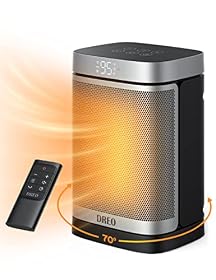 DREO Space Heater, Portable Electric Heaters for Indoor Use with ThermostatDREO
$44.95 as of
View on Amazon De'Longhi Dragon Digital Oil Filled Radiator Heater, 1500W Electric Space Heater for indoor use, programmable…De'Longhi
$189.95 as of
View on Amazon
Product prices and availability are accurate as of the date/time indicated and are subject to change. Any price and availability information displayed on Amazon.com at the time of purchase will apply to the purchase of this product.
Which features are worth paying for?
Worth considering for regular use
- An adjustable thermostat
- At least two heat settings
- Tip-over protection
- Overheat protection
- A timer or automatic shutoff
- A clear power and temperature control system
- A stable base and a cord long enough for safe placement
Useful for bedrooms and offices
- Quiet operation or a fanless design
- A dimmable or switchable display
- A reliable thermostat
- A timer
- A compact footprint that leaves safe clearance around the heater
Often optional
- App control
- Decorative finishes
- Extra-wide oscillation
- A large display
- Included accessories that do not affect heating or safety
Never use an extension cord or power strip with a space heater unless the manufacturer specifically allows it. Plug the heater directly into an appropriate wall outlet, keep clothing and other combustible materials away, and follow the clearance requirements in the manual. Stop using a heater if the plug, outlet, or cord becomes unusually hot, shows damage, or smells burnt.
How to compare two space heaters at different prices
Use this checklist before buying:
- Confirm the room and intended use. A personal heater is not automatically suitable for a large room.
- Compare wattage. This helps estimate electricity use and outlet requirements.
- Check the thermostat. A real adjustable thermostat is more useful than simply having low and high heat.
- Look for required safety protections. Tip-over and overheat protection are important for portable heaters.
- Consider noise. Fan-forced ceramic heaters and fanless radiators have different sound profiles.
- Check dimensions and placement. The heater must fit while maintaining the manufacturer's required clearance.
- Review the warranty and return policy. This matters more for a heater intended for frequent seasonal use.
- Compare the total feature set, not the advertised coverage alone. Coverage claims depend heavily on insulation, ceiling height, outdoor temperature, and room layout.
When the cheapest heater is not the best value
A low-cost heater may be adequate for occasional personal use, but it can be a poor choice if it lacks a thermostat, has inconvenient controls, operates loudly, or is difficult to place safely. Conversely, an expensive heater is not automatically better if its extra features do not match your room or routine.
For occasional use, prioritize basic safety protections, suitable wattage, and a dependable thermostat. For frequent use, consider whether quieter operation, better temperature control, a timer, or a sturdier design will make the heater easier and safer to use. If you need to heat a large area for long periods, compare the ongoing electrical cost and consider whether improving the building's insulation or using the home's primary heating system is more practical.
FAQ
What is the cheapest type of space heater to buy?
Basic ceramic or fan-forced personal heaters are often the least expensive type. Compare safety protections, thermostat controls, wattage, and the return policy rather than choosing only by the lowest listed price.
Are more expensive space heaters cheaper to run?
Not necessarily. Electricity use is driven mainly by wattage and operating time. A more expensive heater may offer better controls or quieter operation, but its purchase price alone does not make it use less electricity.
Is an oil-filled radiator worth the higher price?
It can be worthwhile when quiet, steady heat matters. Oil-filled radiators usually warm more gradually than fan heaters, so they are better suited to extended room heating than quick bursts of heat.
What should I check before buying a space heater?
Check the wattage, room suitability, thermostat, heat settings, tip-over and overheat protection, noise level, dimensions, required clearance, warranty, and whether the heater can be plugged directly into a suitable wall outlet.