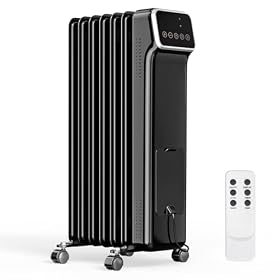
A basement office usually needs a quiet heater with a thermostat, stable placement, and enough output for the room—not simply the highest wattage available. Use room size, insulation, circuit capacity, and humidity to narrow the choice.
Space heater for a basement office
A basement office is often colder than the rest of the home because concrete floors, exterior walls, limited sunlight, and poor insulation pull heat away. The best choice is usually a quiet space heater with an adjustable thermostat, tip-over and overheat protection, and enough wattage for the office size. If the basement is damp, address moisture separately—a heater can make the room feel warmer but will not fix condensation, leaks, or high humidity.
Choose the wattage by room size
Most portable electric heaters draw up to about 1,500 watts on their highest setting. That is generally suitable for supplemental heat in a small or moderately sized office, but actual performance depends on insulation, ceiling height, drafts, and the temperature difference between the basement and the rest of the house.
Use these figures as a starting point rather than a guarantee:
Small office: A lower-wattage setting may be enough, especially if the room is insulated and already receives heat from the home’s HVAC system.
Medium office: A heater with a 1,500-watt high setting is commonly useful for supplemental heat.
Large, open, or poorly insulated basement: One portable heater may struggle to maintain a comfortable temperature. Improving air sealing or using the home’s heating system may be more effective than adding a second heater.
A 1,500-watt heater on a standard 120-volt circuit draws roughly 12.5 amps. Avoid running it on the same circuit as other high-load appliances such as a microwave, portable air conditioner, or large dehumidifier. Plug the heater directly into a wall outlet unless the manufacturer specifically permits another arrangement. Do not use an extension cord or power strip unless the instructions explicitly allow it and the cord is properly rated.
Features that matter in a basement office
Adjustable thermostat
A thermostat helps maintain a steady temperature instead of running the heater continuously. Look for a model with a digital or clearly adjustable thermostat and multiple heat settings. A lower setting may keep the office comfortable while reducing noise and electrical use.
Be aware that the thermostat measures the temperature near the heater, not necessarily at your desk. Keep the unit away from cold exterior walls, drafts, and direct airflow from a vent when possible.
Quiet operation
Fan-based ceramic heaters can distribute warmth quickly, but the fan may be noticeable during phone calls or focused work. An oil-filled radiator is typically a better fit when silent operation matters most, although it warms more gradually and can remain hot after being switched off.
For a desk area that needs quick spot heating, a compact ceramic heater may be more convenient. For several hours of steady background heat, an oil-filled radiator can be more comfortable if there is enough open floor space for safe placement.
Tip-over and overheat protection
Choose a heater with an automatic tip-over shutoff and overheat protection. These are important safeguards, but they do not replace proper placement. Keep the heater on a level, hard, nonflammable surface with clear space around the air intake and outlet.
Do not place it under a desk where clothing, papers, cords, or a chair can block airflow. Keep curtains, furniture, bedding, boxes, and other combustibles away from the unit, following the clearance distances in the manual.
Timer and controls
A timer can be useful when you want the heater to turn off after the workday. Avoid relying on a heater to run unattended or while sleeping unless the manufacturer specifically states that the operating arrangement is safe. Turn it off when leaving the room.
Remote controls and app features are convenient, but they should not outweigh basic safety, thermostat quality, noise level, and stable construction.
Product prices and availability are accurate as of the date/time indicated and are subject to change. Any price and availability information displayed on Amazon.com at the time of purchase will apply to the purchase of this product.
Ceramic heater or oil-filled radiator?
Ceramic heater
A ceramic heater is a practical choice when you want heat quickly, compact size, and easy portability. Its fan circulates warm air through the office, which can help after entering a cold basement. The tradeoff is fan noise and airflow that may feel drafty.
Choose one when:
You need quick warm-up.
You want to move the heater between rooms.
Moderate fan noise is acceptable.
The office has limited floor space.
Oil-filled radiator
An oil-filled radiator heats more gradually and usually operates quietly. It is well suited to a stationary office where you want steady background warmth. It is larger and its surfaces can become very hot, so it needs generous clearance from furniture, papers, and foot traffic.
Choose one when:
Quiet operation is a priority.
The heater can remain in one safe location.
You prefer gradual, steady heat.
There is enough open floor space around the radiator.
Neither type removes basement moisture. If the room smells musty, has condensation, or measures consistently high humidity, inspect for plumbing or foundation leaks and consider appropriate dehumidification or professional evaluation.
Product prices and availability are accurate as of the date/time indicated and are subject to change. Any price and availability information displayed on Amazon.com at the time of purchase will apply to the purchase of this product.
Safe placement near a desk
Place the heater on the floor rather than on a desk, shelf, or other elevated surface unless the manufacturer specifically designed it for that use. Aim warm air toward the occupied part of the room without directing it at papers, curtains, walls, or electronics.
Keep the power cord away from walkways and do not run it beneath rugs or carpeting. Check the plug and outlet occasionally. If the plug, outlet, or cord becomes unusually hot, smells scorched, sparks, or shows damage, stop using the heater and have the electrical issue evaluated by a qualified professional.
A basement may also have a concrete or uneven floor. Make sure the heater sits firmly and that its tip-over switch is not defeated by an unstable surface. Never disable a safety switch or operate a damaged heater.
How to make the heater work better
A space heater is supplemental heat, so reducing heat loss can make a larger difference than moving to a higher setting. Before buying a larger unit:
Check for drafts around basement windows, doors, and exterior penetrations.
Close doors to unused areas if doing so does not interfere with required ventilation or heating-system operation.
Use curtains or insulating window coverings where appropriate.
Keep the heater’s intake and outlet clear of dust and furniture.
Use a separate thermometer at desk height to judge the actual working temperature.
Address dampness, leaks, and excessive humidity rather than trying to heat through the problem.
Do not cover a heater, modify its controls, or use it to dry clothing, towels, or other materials.
When a space heater is not the right fix
A portable heater may be inadequate if the basement office is large, extremely drafty, or separated from the home’s heating system. A persistent cold floor, damp wall, or strong temperature difference may indicate insulation, air-sealing, moisture, or HVAC problems.
If the circuit trips repeatedly, do not simply reset the breaker and continue using the heater. Unplug other loads and have the circuit checked if the problem persists. If you need more heat than one standard portable unit can safely provide, consult an HVAC or electrical professional instead of connecting multiple heaters to one circuit.
For a typical small basement office, prioritize a thermostat, quiet operation, tip-over protection, and safe placement over extra features. Choose ceramic for fast spot heat or an oil-filled radiator for quieter, steadier warmth, and treat basement moisture and insulation as separate issues.
FAQ
What wattage space heater is best for a basement office?
A heater with a maximum setting around 1,500 watts is commonly used for supplemental heat in a small or medium office, but insulation, drafts, ceiling height, and room layout affect results. Confirm that the electrical circuit can safely handle the load alongside other appliances.
Is a ceramic heater or oil-filled radiator better for a basement office?
A ceramic heater warms the room quickly and is usually compact, but its fan creates noise. An oil-filled radiator warms more gradually and is typically quieter, making it useful for extended office work if you have enough safe floor space.
Can I use a space heater with an extension cord in a basement office?
Do not use an extension cord or power strip unless the heater manufacturer explicitly permits it and the equipment is properly rated. Plugging a high-wattage heater directly into a suitable wall outlet is the safer general practice.
Will a space heater reduce basement humidity?
No. Heating may change how moisture feels or where condensation forms, but it does not remove moisture. Investigate leaks, condensation, ventilation, and humidity separately, and use suitable moisture-control equipment when needed.
Can I leave a space heater running while I am away from my basement office?
It is safest to turn a portable heater off when leaving the room. Use timers only as directed by the manufacturer, and never operate a damaged heater or one with blocked airflow.